

Entecon Industries is an independent UK manufacturer operating from a fully equipped fabrication workshop in Surrey, in the UK, where it has produced bulk solids handling solutions for more than 60 years.
The company first introduced the Entecon Aero Mechanical Conveyor (AMC) in the 1960s, initially for agricultural use before expanding into the food and chemical sectors.
Since then, the company has continually developed its range of process machinery and now supports thousands of customers worldwide with technical expertise, servicing of existing equipment and the design and manufacture of new systems.
Under new ownership and management, the organistion is determined to re‑establish itself as a market leader in the bulk solids handling industry, offering solutions for dry, hazardous and difficult‑to‑handle materials.
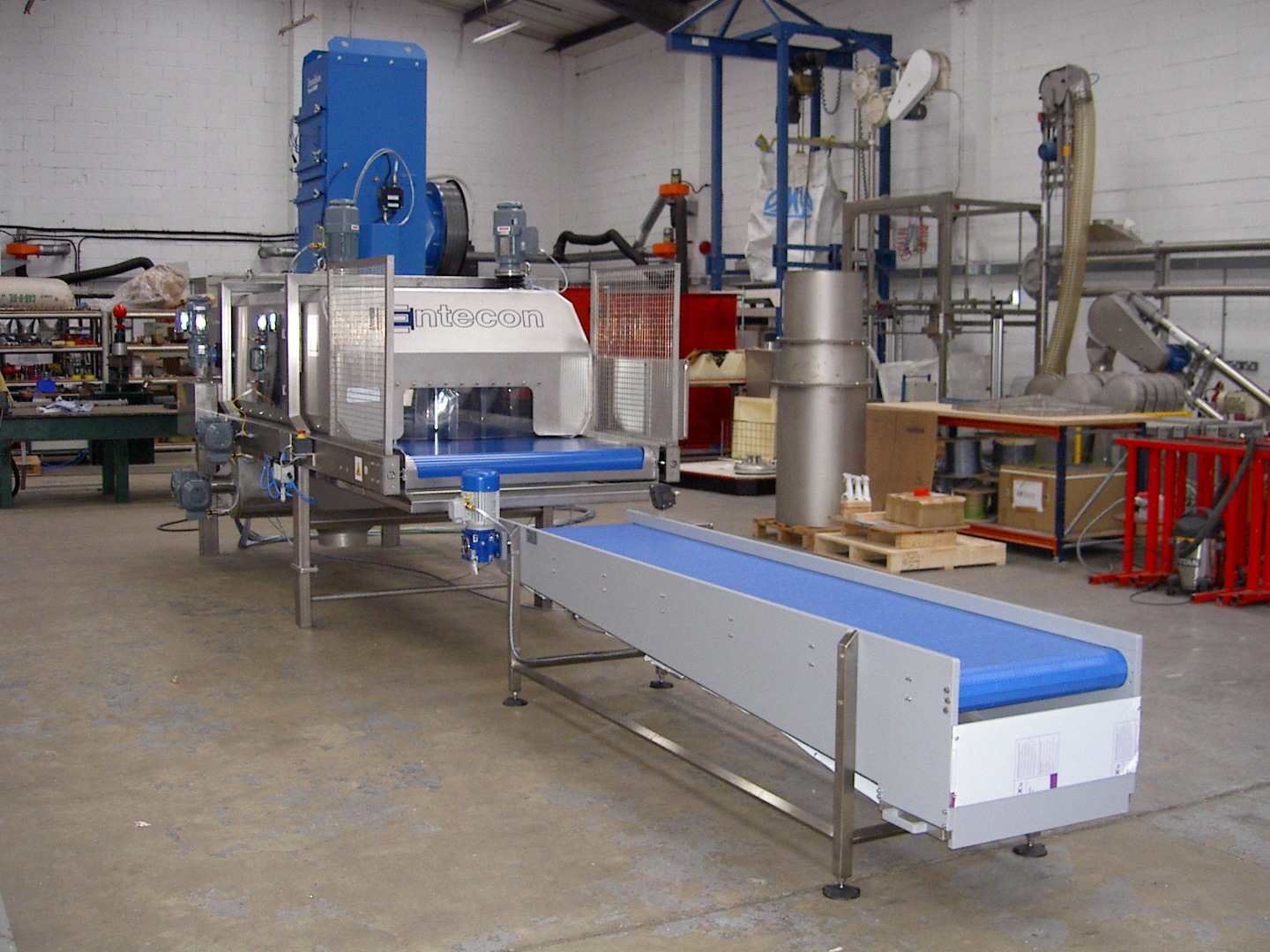
This feature examines a recent project for a fertiliser manufacturer requiring an Entecon FIBC Discharge Station (FDS) and AMC conveyor for an extremely challenging powder‑handling application.
The challenge: Low minimum ignition energy
The customer processes several fine powders, including sulphur powder, zinc oxide, manganese carbonate and urea.
The final product has an exceptionally low Minimum Ignition Energy (MIE) of just 6–10 mJ, meaning even minor electrostatic discharge could trigger a catastrophic dust explosion.
To ensure safe operation, the system required full earth bonding to <5 ohms, exclusive use of T4‑rated components (MIT 125°C) and no exposed aluminium parts, as contact between aluminium and the product can cause violent reactions.
These requirements were compounded by additional hazards including complex risk zoning, static accumulation and regulatory compliance gaps.
The internal environment of the conveyor experiences continuous, turbulent dust clouds, requiring an ATEX Zone 21 internal classification, while the external area around the bulk bag station experiences occasional dust emissions during bag connection, defining it as ATEX Zone 22 external.
The customer’s original system relied on ungrounded components and high‑friction internal parts; in an aero‑mechanical conveyor, where a wire rope and discs travel at high speed, friction generates rapid static charging, easily exceeding the product’s ignition threshold.
Operating non‑certified machinery in designated ATEX zones also breached corporate safety requirements and local legislation, risking regulatory penalties, insurance loss and potential facility shutdown.
The solution: a fully certified entecon atex powder handling system
Entecon carried out a detailed assessment of the powder’s ignition characteristics, zoning requirements, throughput targets and existing process constraints before engineering a complete ATEX‑compliant handling solution.
This included hazard analysis, equipment selection, earth‑bonding strategy, equipment integration, commissioning support, static dissipation testing and full compliance documentation. The final system comprised two key elements: the Entecon FIBC Discharge Station (FDS) and the Entecon Aero Mechanical Conveyor (AMC).
- Entecon FIBC discharge station (FDS) — Zone 22 external
The FDS provides dust‑tight bulk bag discharge through a sealed docking interface, maintaining a clean Zone 22 environment. Active grounding interlocks ensure safe dissipation of static generated within the bag, with a Type C conductive FIBC selected for additional protection. Controlled product flow is achieved through pneumatic bag massagers and vibrating plates, ensuring smooth feed into the conveyor inlet and preventing friction‑inducing blockages, particularly beneficial for cohesive powders.
- Entecon Aero Mechanical Conveyor (AMC) — Zone 21 internal
The AMC conveys material at high velocity by displacing air inside a sealed tube. To meet ATEX Category 2D Zone 21 requirements, equipotential bonding was applied to all metal housings, flanges and frames, ensuring uninterrupted dissipation of static charge. Friction monitoring was incorporated through an ATEX‑rated motor, sensors to detect rope sprocket slip and an additional temperature sensor for enhanced protection.
What Entecon achieved for the customer
The system delivered full compliance with ATEX Zone 21 internal and Zone 22 external requirements, dust‑free high‑throughput operation, elimination of unmanaged static discharge risks, safe handling of powders with an MIE of 6–10 mJ, a successful return to production and reliable long‑term operation.
The Entecon Automatic Sack Opener (ASO) and ASO‑bale
Entecon has also developed a high‑capacity machine for opening sacks and bales: the Automatic Sack Opener (ASO).
Designed for heavy‑duty industrial use, the ASO automatically opens, empties and disposes of sacks or bales at a rate of one bag every 12 seconds.
Two versions are available: the ASO for powders, granules, seeds and grains, constructed in 304 stainless steel with optional 316L and available in ATEX‑compliant versions; and the ASO‑Bale for compressed fibre bales and solid materials.
The ASO‑Bale can automatically open different bale sizes without manual adjustment and separates plastic wrapping into a dedicated waste stream.
Entecon recently supplied an ASO‑Bale system to a manufacturer handling three different bale sizes containing a carcinogenic material. The machine was built to the customer’s specification, incorporating Allen Bradley Rockwell components and SMC/Norgren pneumatics for seamless integration and reduced spares inventory.
The automated solution eliminated the need for two operators in full PPE to manually slit bags, significantly improving safety and efficiency.
A complete range of dust‑control solutions
Alongside the ASO, Entecon offers Sack Tip Stations and Bulk Bag Discharge Stations featuring a unique bag‑clamping system. All machines are bespoke, cost‑effective and designed to integrate with existing plant equipment, providing industry with robust solutions to dust control and safe powder handling.