

British Rema might just be the company that businesses may not have come across, but it is one that has long been at the forefront of milling and grinding technology. Based in Chesterfield in the UK, the SME is a long-established and well renowned UK engineering company specialising in powder processing, particle size reduction, milling, grinding, micronising and in particle size control technologies for customers around the globe.
Now approaching its centenary year, the company was founded in 1927 to develop roller mills for the coal industry and it later expanded into powder processing, equipment and rotary engineering. Tony Goodwin, the firm’s managing director, discusses milling and grinding technology.
What is the purpose of milling and grinding technology when it comes to processing bulk solids? Why would an operator need to grind product, for example?
Milling and grinding technology is used in bulk solids processing to reduce the size of particles, which can dramatically influence the physical properties of a material. These technologies are essential in industries such as food processing, pharmaceuticals, chemicals, mining, cement and agriculture because many products must meet strict particle size requirements before they can be used effectively in specific processes, where particle size affects the product’s physical reactivity and performance, including packaging and transportation.
There are a variety of practical and economic reasons why an operator must grind a product reduce the particle size. The obvious one is to meet the specifications of the customer who requires a certain powder fineness or particle distribution.
However, more and more it is to improve process efficiency – moving particles more easily through mixers, conveyors and reactors and to enhance product performance. An example would be in the food sector where finely ground flour produces smoother baked goods, or in the production of paints where fine pigments create better paint coverage. Of course, commercially, there is always a focus on increased productivity and lower costs and so the focus is also on minimising waste and increasing maximum product yield.
Have you seen any particular milling trends recently that is products that are being handled more or less than in the last five years?
High performance polymer milling and grinding focussed on the growth in the additive manufacturing market (3D printing) presents some specific challenges around particle size distribution. Many other changes are being driven by incoming regulations such as PFAS, pushing customers to seek alternatives to harmful forever chemicals, which may respond very differently to grinding processes or need a completely different particle size distribution.
There is a growing trend in the requirement for ultra-fine powders under 10 microns for the pharmaceutical, chemical and food sectors where demand is for smoother textures, instant solubility and cleaner formulations. In the food sector this is driven by wellness consumers who are seeking plant proteins, alternative proteins, spices and ingredients, nutraceutical powders and functional ingredients. This has increased demand for jet milling, classifier milling and micronising systems.
What types of milling and grinding technologies are out there? Can you explain the advantages and drawbacks?
The most common machines for dry material milling include:
Air micronisers (Jet mills): These are ideal for producing ultra-fine powders, particularly when starting with already fine feed.
These mills use extremely fast air jets to cause particle collisions within a high intensity airstream so that particles are reduced in size by means of impact and attrition grinding. Air micronisers are available in opposed jet and spiral flow configurations – the latter being able to handle harder materials and offering precise particle size control.
Jet mills are designed for throughputs of between 0.5 kg and 2 tonnes per hour. Spiral flow jet mills are designed for throughputs of between 1 kg and 100 kgs per hour. Compared to other milling technologies jet mills tend to have low throughput rates and high energy consumption.
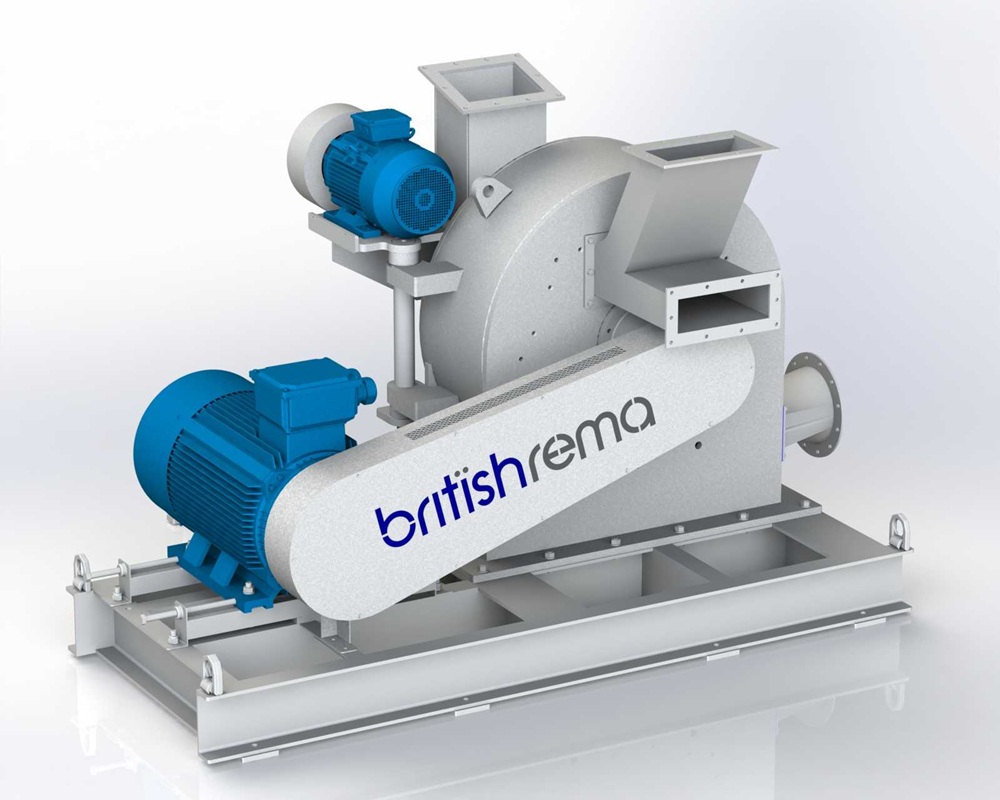
Rotary impact mills: There are also called beater mills, which use high-speed rotors to impact particles against liners and themselves.
They are suitable for materials up to three on the Mohs hardness scale and effective for medium-coarse to fine grades, typically with a D50 within the 30-to-100-micron range. Rotary impact mills are widely used for reducing particle size in the chemicals, food, metal powders, minerals and plastics industries. It can be hard to achieve a narrow particle size distribution on these types of mills, even with the incorporation of screens within the milling chamber.
Highly abrasive products can also rapidly reduce the life of both the rotating and static grinding components.
Classifier mills: These hybrid machines are a combination of impact rotor and precise classifier wheel machines and are suitable for applications requiring tightly controlled distributions. Classifier mills can also handle products with complex melting or softening points due to options for chilled or secondary air injection. They are used for throughputs of between 1 kg and 6 tonnes per hour.
Ball mills and other tumbling mills (tube mills, rod mills and batch mills): These have been used for centuries and are used for robust, coarse or fine grinding across a range of mineral applications, especially where longer retention times or heavy-duty size reduction are required.
Their low rotational speeds combined with simple and robust construction make them ideal for grinding hard and abrasive materials where continuity of service, low maintenance and minimum down time are a necessity.
British Rema has for many years been amongst the leaders in design and application of ball mills and milling systems for the size reduction of a wide variety of materials including minerals, ores, coal, carbon products and general chemicals.
Ball mills can be used in conjunction with a wide range of units in a variety of forms in both open and closed-circuit with an appropriate classifier that can control the final product size and system efficiency. With larger units especially demanding high capitol expenditure, return on investment calculations can often be challenging.
How does product type affect the type of milling/grinding technology an operator chooses? For example, food stuff versus pharmaceuticals?
The type of product being processed has a major influence on the milling or grinding technology an operator selects because different materials behave very differently during size reduction. Factors such as density, heat sensitivity, particle shape, contamination risk, moisture content, hygiene requirements and target particle size all affect the choice of equipment and process conditions.
In practice, milling technology is selected not just to achieve a certain particle size, but also to preserve product quality, safety, functionality and regulatory compliance. It sounds obvious, but food milling focuses on hygiene, temperature control, taste and texture preservation and the avoidance of contamination.
Food products such as flour, sugar, spices, coffee, starch and proteins are dependent on milling technologies.
What common issues arise with milling and grinding? And how can an operator avoid them?
As with every technology there will be issues while perfecting the required product for the customer. In milling and grinding operations it is necessary to consider particle size control, heat generation, contamination, material flow behaviour and system efficiency etc.
Selecting the optimum solution and then thorough testing is key to overcoming common issues such as heat build-up, mill speed and incorrect particle size. Too much heat can cause product degradation, moisture migration, loss of aroma and flavour etc. The operator will need to optimise mill speed and feed rate to eliminate friction and reduce temperature.
It could be a case of incorrect settings, worn components or overloading the mill, but these can be overcome by working with the manufacturer to establish best practise. Using inherently cooler milling technologies such as jet mills can be especially useful because particle reduction occurs via particle-to-particle collision in a decompressing, cool gas.
Inconsistent particle size is another common issue and can be caused by uneven feed, overloading the mill, material moisture as well as the possibility of incorrect settings and worn components. Reduction in product quality, texture variation in food or poor tablet compression can all result from this. Air classifier mills separate oversized particles automatically, thus helping to improve uniformity, yield and reproducibility.
Other issues, such as control of feed consistency, cross contamination and product build up/caking, can be overcome with automated feeders, appropriate mill construction, cleaning protocols and moisture and temperature control systems. Essentially, working with a specialist supplier, such as British Rema, enables customers to specify the correct equipment for the application.
What are the safety/compliance/training issues to consider?
The very nature of processing demands that operators practise strict Health & Safety Management Systems, carrying out COSHH analyses and chemical task risk assessments for all the materials they process and creating Safe Systems of Work for all processes and tasks.
The impact of every material for processing must first be assessed for the plant or process it is assigned to and each plant must be equipped with the necessary controls. A thorough risk assessment will be needed and designing appropriate engineered solutions around feed in and collection points will be critical to operator safety.
As a minimum, operators will be required to wear the correct personal protective equipment (PPE), for both their own protection and, in some cases, also for the protection of the material itself.