

Accurate inventory visibility has always been a central requirement in bulk material handling.
Whether companies manage wood chips, sand, clinker, granulates, biomass, or recycling materials, knowing how much material is currently available directly impacts procurement, production planning, logistics coordination, and financial reporting.
Yet despite the strategic importance of inventory transparency, many industrial operations still rely on methods that are fundamentally limited in terms of accuracy, frequency and scalability. Manual measurements, visual estimations, truck weighing, or periodic drone inspections may provide approximations, but they rarely deliver the continuous, reliable data required in modern industrial environments.
This challenge becomes even more critical in industries where raw material consumption fluctuates daily. Small deviations in inventory assumptions can accumulate over time, leading to procurement inefficiencies, unexpected shortages, overstock situations, or inaccurate reporting. Against this backdrop, 3D LiDAR (Light Detection and Ranging) technology has emerged as a powerful solution for automated volume monitoring.
By continuously capturing the geometry of stockpiles and converting this information into volumetric data, LiDAR enables automated real-time inventory transparency with minimal manual effort. The practical relevance of this technology can be illustrated through the example of Sauerland Spanplatte, a German manufacturer specialising in high-quality tubular particle boards.
The company implemented a LiDAR-based monitoring solution to replace labour-intensive manual inventory processes and establish continuous visibility across its raw material storage areas.
Why bulk material volume monitoring is challenging
Accurately determining the volume of bulk materials is far more complex than it may initially appear. In industrial environments, stockpiles are dynamic systems that constantly change in shape, size and composition as materials are delivered, moved, consumed, or compacted during daily operations. Unlike standardised goods with clearly defined dimensions, bulk materials form irregular surfaces that are difficult to quantify precisely using conventional methods.
The challenge begins with the geometry of the material itself. Bulk materials such as sand, lime, fertilisers, or granulates rarely form uniform piles. Instead, they create uneven surfaces with varying slopes, cavities and compaction zones. Even small changes in pile geometry can significantly affect the calculated volume.
As a result, simple visual estimations often fail to provide the level of accuracy required for reliable operational planning.
Environmental complexity and the need for reliable inventory data
Environmental conditions further complicate the measurement process. Many storage areas are exposed to dust, fluctuating lighting conditions, weather influences, or restricted visibility. Covered storage halls introduce additional challenges because measurement systems must operate reliably indoors while coping with structural obstacles such as support beams, machinery, or conveyor systems.
In outdoor environments, changing weather conditions can affect accessibility and measurement consistency.
At the same time, industrial operations require increasingly frequent and accurate inventory data. Procurement teams must ensure that sufficient material is available to maintain uninterrupted production while avoiding unnecessary overstocking that ties up capital and storage capacity.
Inaccurate stock information can therefore have immediate operational consequences.
Underestimating inventory levels may lead to unnecessary deliveries and inefficient logistics coordination, while overestimating available material can result in unexpected shortages and costly production interruptions.
The growing demand for real-time inventory data
Another important factor is the growing role of data-driven decision-making in industrial operations. Modern production environments increasingly depend on continuously available operational data to improve forecasting, optimise logistics and increase process efficiency. Periodic inventory checks, which only provide isolated snapshots of the storage situation, are often insufficient for these requirements. Instead, companies need measurement systems capable of delivering reliable, up-to-date information in real time.
The example of Sauerland Spanplatte illustrates how these challenges converge in practice. The company required a solution capable of handling irregular stockpile geometries, fluctuating consumption patterns, covered storage environments and demanding environmental conditions while simultaneously providing accurate and continuously available inventory data.
These requirements ultimately highlight why conventional measurement approaches often reach their practical limits in modern bulk material handling environments.
The limitations of traditional volume measurement methods
For many years, companies handling bulk materials had only a limited selection of methods available for determining inventory volumes.
Although these approaches were often sufficient for rough estimations, they rarely provided the accuracy, consistency, or measurement frequency required in modern industrial environments. As operational processes become increasingly data-driven, the shortcomings of conventional measurement methods are becoming more apparent. One of the most widespread approaches is still manual measurement.
In many facilities, employees determine stockpile dimensions using measuring rods, measuring wheels, or visual assessments. While experienced personnel can often estimate fill levels reasonably well, the process remains inherently subjective.
At Sauerland Spanplatte, the monthly inventory process relied heavily on manual measurements. Employees physically inspected the storage areas and estimated stockpile dimensions using measuring equipment.
This approach required considerable time and labour while simultaneously delivering only limited precision. In addition, measurements represented isolated snapshots rather than continuously updated inventory information.
Between inventory checks, stock levels changed constantly due to ongoing production consumption and incoming deliveries, meaning that actual inventory conditions could already differ substantially from the most recent measurements. Another common approach involves estimating inventory indirectly through weight-based calculations.
Incoming and outgoing deliveries are documented using truck scales and inventory levels are derived from the recorded material flows.
While this method can provide useful information about deliveries and consumption trends, it does not reliably reflect actual stockpile volumes. Material losses, compaction effects, moisture variations, or inconsistencies in process documentation gradually introduce deviations over time. As a result, the calculated inventory often drifts away from the real physical stock situation.
Drone-based measurements and their limitations
In recent years, drone-based measurement systems have emerged as an alternative capable of improving volumetric accuracy.
Equipped with GPS-supported cameras or laser scanning technology, they are able to provide detailed surface models of stockpiles and comparatively precise volume calculations. Particularly in large outdoor storage yards, this approach can offer significant advantages over manual measurements.
However, drone-based solutions also introduce important operational limitations. Measurements are typically periodic rather than continuous, meaning they still provide only isolated inventory snapshots. Each flight requires planning, operation and data processing, which increases operational effort. Personnel need to be trained to fly the drone or contractors have to be hired periodically to perform the measurements, which can be quite costly.
Weather conditions such as rain, wind, or poor visibility may further restrict usability. In addition, covered storage halls or indoor storage areas often present major challenges for drone navigation and data acquisition.
Sauerland Spanplatte also evaluated the use of drones for inventory monitoring. Although the technology appeared promising from an accuracy perspective, the company ultimately considered the solution impractical for daily operations. The required effort for repeated drone flights, combined with the limited suitability for covered storage areas, conflicted with the goal of establishing a continuously available and low-maintenance inventory monitoring process.
Understanding LiDAR-based volume monitoring
3D LiDAR technology combines precise spatial sensing with automated data processing, capturing the complete geometry of a storage environment and converting it into actionable volumetric information in real time.
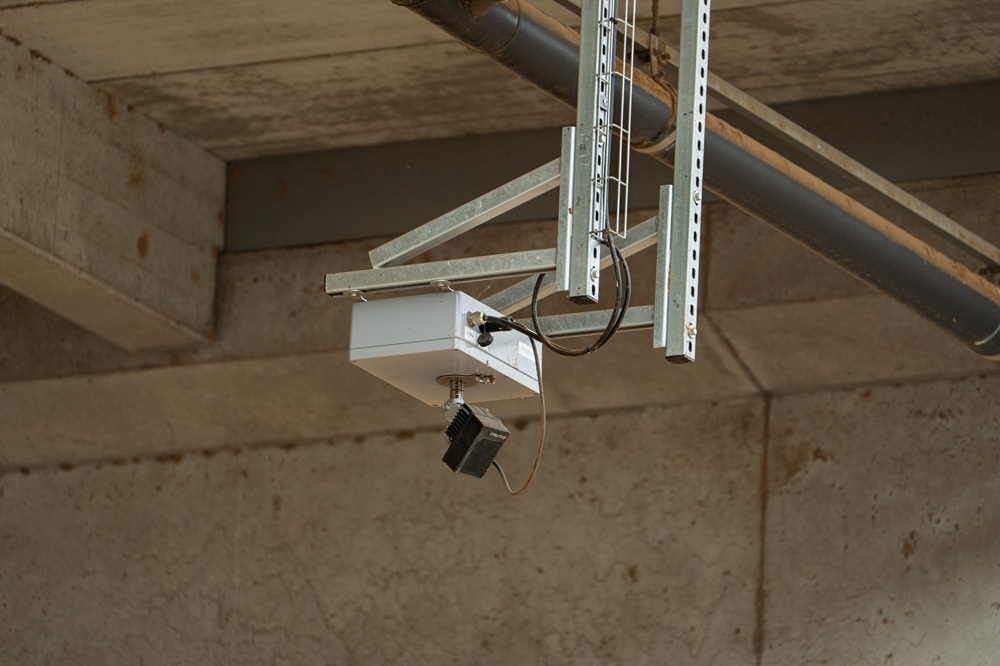
Unlike mobile or periodically deployed measurement systems, LiDAR sensors are typically installed permanently above storage areas, enabling fully automated and continuous monitoring without manual intervention. LiDAR is an optical measurement technology based on the time-of-flight principle. A LiDAR sensor continuously emits hundreds of thousands of laser pulses per second into its surroundings.
When these laser pulses hit a surface, the reflected light returns to the sensor. By measuring the exact time required for the signal to travel back, the system calculates the distance between the sensor and the measured object with high precision.
Unlike conventional single-point laser systems, however, modern 3D LiDAR sensors scan entire environments continuously across multiple directions and angles. Every reflected laser pulse generates a spatial coordinate in three-dimensional space. Combined together, these coordinates form what is known as a point cloud — a dense digital representation of the surrounding environment. In the context of bulk material monitoring, this point cloud accurately captures the surface geometry of stockpiles, silos, or storage areas.
From spatial information to actionable volume data
However, the point cloud itself represents only the raw measurement data. To derive meaningful inventory information, the captured data must be processed into volumetric calculations. The first step in this process involves defining the relevant measurement zones. Virtual boundaries are configured within the software to isolate specific storage areas or separate different material types. This zoning functionality is especially important in industrial environments where multiple stockpiles are stored close to one another.
Once the measurement area has been defined, the LiDAR system processes the captured point cloud to calculate the volume of the stored material. The software analyses the surface geometry of the stockpile and converts the spatial data into volumetric information by dividing the area into smaller sections and calculating their combined volume.
Even in complex storage environments where parts of the surface may be temporarily obscured by shadows, steep slopes, or infrastructure, the system can compensate for missing data using mathematical estimation methods. This enables reliable and highly accurate volume calculations even under challenging industrial conditions.
Reliable operation even in dust or darkness
One of the major advantages of LiDAR technology is its ability to operate reliably under difficult environmental conditions.
Unlike camera-based systems, LiDAR does not depend on ambient lighting and is, therefore, largely unaffected by darkness or changing illumination conditions. In addition, the laser-based measurement principle performs robustly in dusty environments where optical imaging systems often struggle. This robustness was particularly relevant for Sauerland Spanplatte, where high dust levels inside the storage halls represent a demanding operating environment. Despite these conditions, the LiDAR system has demonstrated stable and reliable continuous operation.
Real-time dashboards for inventory transparency
The processed volumetric data is ultimately made available through a centralised monitoring dashboard. Instead of relying on periodic manual inventory checks, operational personnel gain continuous access to current inventory levels, historical trends and material consumption developments. At Sauerland Spanplatte, responsible personnel receive automated daily updates on inventory levels, enabling faster and more informed procurement decisions. Volumes can be viewed both in cubic metres and converted material quantities such as metric tons, creating a direct operational link between spatial measurements and production planning requirements.
From manual estimation to continuous inventory transparency
Accurate volume monitoring has become an essential requirement for efficient bulk material handling. Traditional measurement methods, such as manual estimations or periodic inventory checks, often struggle to provide the level of accuracy, consistency and transparency required in modern industrial operations.
As production environments become increasingly data-driven, the demand for continuously available inventory information continues to grow. 3D LiDAR technology offers a practical and scalable solution to these challenges.
By continuously capturing the geometry of stockpiles and converting this data into precise volumetric information, LiDAR enables real-time inventory transparency with minimal manual effort. The technology combines high measurement accuracy with reliable operation under demanding conditions such as dust, poor lighting, or covered storage environments, making it particularly well suited for industrial applications.
The example of Sauerland Spanplatte demonstrates how LiDAR-based volume monitoring can generate measurable operational benefits in practice. By replacing labour-intensive manual inventory processes with automated and continuous measurements, the company improved inventory transparency, reduced manual effort, accelerated inventory checks and established a more reliable basis for procurement and operational decision-making.
Beyond the immediate operational advantages, continuous volume monitoring also creates the foundation for broader digitalisation initiatives.
Reliable real-time inventory data enables companies to better understand consumption patterns, optimise processes and improve planning accuracy across multiple sites. As industrial companies continue to pursue greater efficiency, transparency, and automation, LiDAR-based volume monitoring is likely to become an increasingly important component of modern bulk material management. For more information: Visit blickfield.com